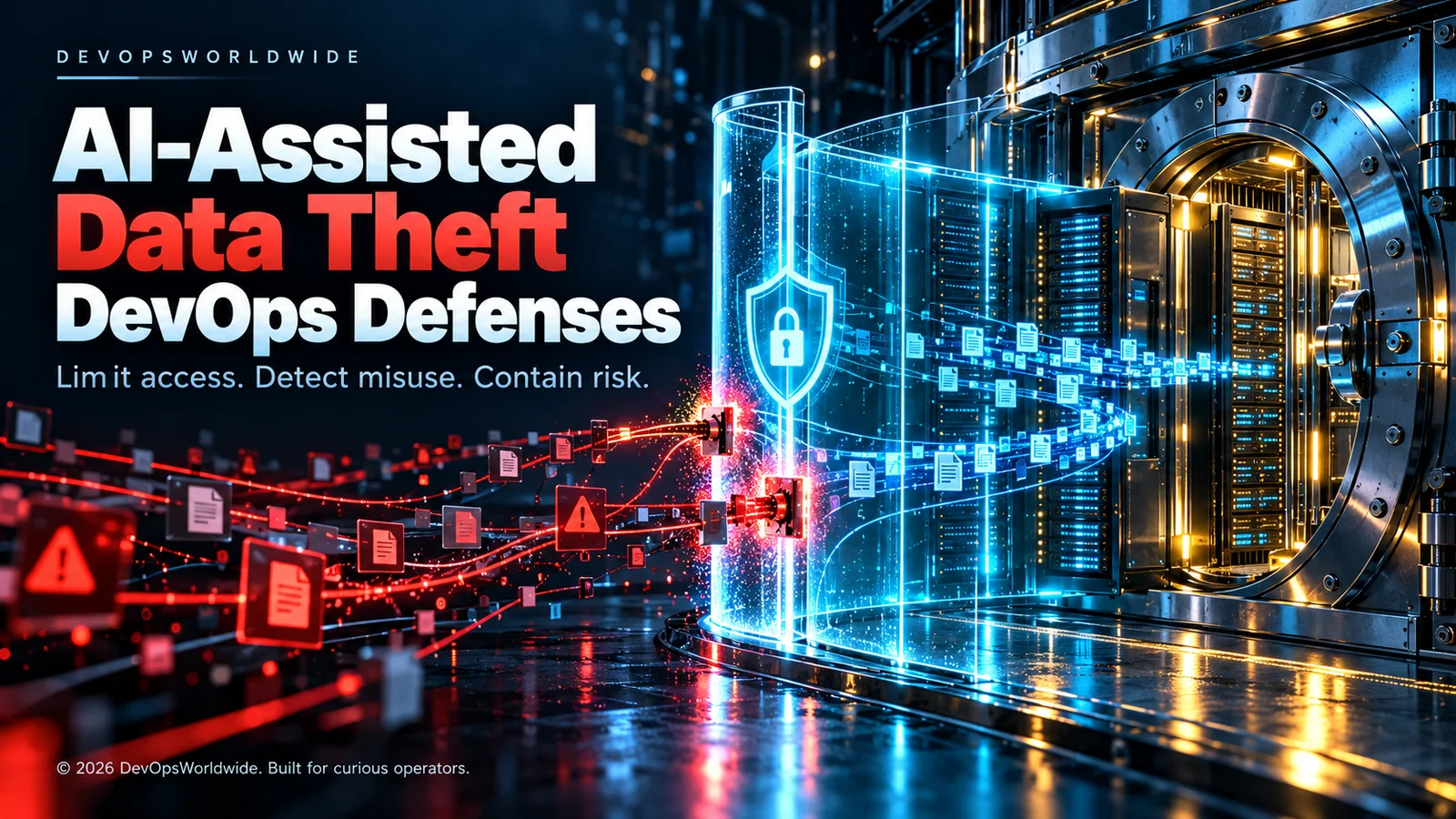
A deployment credential should let a pipeline deploy an application. It should not become a route into customer databases.
That boundary matters regardless of who is using the credential. With AI helping attackers investigate unfamiliar systems and automate work, teams have another reason to check how much access one compromised identity can unlock.
What the report actually says
In its September 2026 threat intelligence report, Anthropic described disrupted activity involving operators it suspected were affiliated with ShinyHunters. According to the company, attackers used Claude to assist with investigating systems, developing tools, and stealing data.
The report covers activity observed between December 2025 and August 2026. These are findings reported by the model provider, rather than an independent forensic assessment by DevOpsWorldwide. This article examines that published report; it does not announce a new breach on October 24.
One distinction matters: Anthropic said the API keys involved in this activity were stolen from customers’ environments, and that its own systems were not compromised by this actor. This was reported misuse of AI during attacks—not evidence that ordinary conversations with an AI assistant automatically exposed users’ data. Source: Anthropic’s September 2026 report
What AI changes for defenders
Anthropic describes operators using AI to interpret unfamiliar developer APIs and create tools for collecting data. This can reduce the manual work between obtaining access and using it. The report does not establish that every attacker works at the same speed or that AI can bypass every control. Source: Anthropic’s September report
Our operational takeaway is about the time available to respond. If an attacker can investigate an unfamiliar environment with less manual effort, a team should not assume it has a long quiet period after a credential is exposed. Limit what that credential can reach, make unexpected activity visible, and rehearse containment before an incident.
A deployment identity is the account or role a release job uses to act on infrastructure. Workload identity lets software prove which job or service it is, so it can request scoped, temporary access. Neither approach makes a compromised job harmless: its permitted actions still matter.
Start with the credential, not the AI headline
For a DevOps team, a useful first question is:
If someone obtained our deployment identity, what could they reach before we stopped them?
Consider a hypothetical pipeline that deploys an application but also has permission to read unrelated storage and change access policies. The application may be secure, yet the pipeline identity creates a separate path to sensitive resources.
Review access around the job being performed. A deployment role, a reporting service, and a backup process have different needs. Sharing a powerful identity between them makes a compromise harder to contain.
AWS recommends temporary credentials and permissions limited to the actions and resources required. Temporary credentials reduce the lifetime of an exposed credential; they still need carefully scoped permissions. Sources: AWS credentials guidance and IAM security best practices.
Treat the pipeline as a production system
Build environments deserve the same attention as the applications they release.
Review which jobs receive secrets, who can change those jobs, and whether untrusted contributions can execute alongside privileged credentials. Protect deployment configuration changes with review, and separate ordinary testing from privileged release operations.
Where supported, exchange workload identity for temporary cloud credentials instead of storing permanent cloud keys in the pipeline. OWASP includes this approach in its CI/CD security guidance. Source: OWASP CI/CD Pipeline Security
A useful review should identify the specific repository, branch or protected environment permitted to request deployment access. Replacing a stored key does not remove the need to restrict which workloads can obtain credentials.
Ask what would trigger an investigation
An alert is useful only if someone can act on it.
For your own environment, identify the events that would deserve investigation: an unexpected permission change, a deployment identity reading customer data, or an unusual export from a sensitive datastore.
Then test the response using synthetic data in an isolated environment. Does the event appear in the available logs? Does an alert reach the right person? Can that person identify the credential owner and restrict access?
This exercise should produce evidence about your controls—not a claim that one monitoring rule detects every AI-assisted attack.
Rehearse containment
A response plan should answer practical questions before an incident:
- Who can disable the affected identity?
- How will active sessions and any newly created credentials be investigated?
- Which dependent services will be affected by revocation?
- Where is evidence preserved?
- Who verifies that access has actually stopped?
Replacing an exposed secret is one action. Establishing whether an attacker created another route back in is a separate investigation.
A useful task for the next sprint
Choose one production deployment identity. Document its owner, permissions, credential lifetime, and revocation procedure. Check whether its access matches its actual job, then rehearse the response to its compromise in a safe environment.
Record the result in a small evidence sheet:
| Question | Evidence to collect |
|---|---|
| What can this identity access? | Reviewed permissions and resource scope |
| Who owns it? | Named team and incident contact |
| Would unexpected activity be visible? | A synthetic test event and its matching log entry |
| Would someone investigate? | Alert delivery and acknowledgment |
| Can access be contained? | A tested revocation procedure and follow-up access check |
The most useful outcome from an AI-related breach headline is a specific improvement your team can demonstrate.
This article provides defensive analysis. It does not reproduce stolen information or instructions for accessing affected systems. The scenario and exercise are illustrative; no incident simulation is claimed to have been executed.