Security is often introduced to delivery as a final approval step: a spreadsheet, a ticket, or a late request to prove that a release is safe. That model protects neither security nor speed. It sends problems downstream, where changes are expensive and context is thin.
Policy as code offers a better operating model. It expresses a small set of security and reliability expectations in versioned, testable rules that run where engineers already work: pull requests, infrastructure plans, build pipelines, artifact promotion, and Kubernetes admission. The aim is not to automate judgement out of delivery. It is to make the routine, high-confidence decisions consistent and the exceptional decisions visible.
Good guardrails make the safe path the easiest path. They explain what failed, show how to correct it, and reserve human review for real trade-offs.
Why friction appears in the first place
Most delivery friction is not caused by a security requirement itself. It comes from a requirement arriving without a clear owner, a repeatable test, or a fast feedback loop. Engineers then receive a vague instruction such as “use secure defaults” after the system has already been designed.
Policy as code changes the sequence:
| Late-stage security | Policy in the delivery path |
|---|---|
| Review after the release is assembled | Feedback while the change is still small |
| Evidence scattered across tickets | Policy, tests, and exceptions live with the change |
| A binary approval with little context | A precise result with a remediation path |
| Repeated manual checking | Automation for stable, well-understood controls |
The Open Policy Agent project describes policy as code as a way to express declarative policy and separate policy decisions from enforcement. That makes it useful across CI/CD, Kubernetes, APIs, and more—not just at one tool boundary. OPA’s CI/CD guidance is a useful technical reference, but the team workflow matters just as much as the language you choose.
Start with policy intent, not a policy engine
The first question is not “Should we use OPA, Kyverno, or a vendor tool?” It is: what unsafe or non-compliant change do we want to prevent, detect, or review?
Write each intended control in plain language before encoding it:
Production workloads must define CPU and memory requests.
Public ingress endpoints require TLS.
Container images must come from approved registries.
High-severity dependency findings require an explicit exception or remediation plan.
Then decide the right response:
- Inform: surface the signal but do not block the change yet.
- Warn: require acknowledgement and create a follow-up.
- Require review: route a higher-risk change to a named owner.
- Block: prevent the change because the risk is understood and the remediation is straightforward.
Starting in “inform” mode is not weakness. It lets a platform or security team learn which rules are noisy, which repositories need better defaults, and which teams require enablement before enforcement becomes fair.
A policy is a product for engineers
Treat every policy like a small internal product. A useful policy has:
- A clear purpose and risk statement.
- A named owner who can refine it.
- Examples of compliant and non-compliant changes.
- A useful failure message with a corrective action.
- Tests, version history, and a documented exception path.
An opaque denial message creates work. A specific message creates learning:
Denied: deployment/payments-api does not define resources.requests.memory.
Why: requests allow safe scheduling and cost-aware capacity planning.
Fix: define CPU and memory requests, or request a time-bound exception.
This same principle applies to supply-chain checks. GitHub’s dependency review can show dependency changes in a pull request and be configured to fail on selected vulnerability severities or licence conditions. It is valuable because the decision is made before a new component is merged, not after it reaches production. GitHub’s dependency review documentation explains the supported workflow.
Put the right policy at the right control point
Security checks become frustrating when they repeat everywhere or run only at the last possible gate. Map controls to the moment where the most useful evidence exists.
| Delivery point | Best policy questions | Typical response |
|---|---|---|
| Local development | Are secrets, unsafe defaults, or prohibited patterns present? | Fast hint or pre-commit feedback |
| Pull request | Did this dependency, IaC plan, or workload manifest introduce risk? | Status check with remediation |
| Build and package | Is the artifact traceable, scanned, and produced from trusted inputs? | Promote only verified artifacts |
| Deploy | Does the target environment satisfy the requested constraints? | Approve, require review, or stop |
| Runtime | Did configuration drift or a risky workload appear? | Alert, audit, or controlled admission decision |
Do not make every rule blocking. A missing label on a development namespace might be an actionable warning. A privileged container in production deserves a stricter response. The control should match the impact, reversibility, and confidence of the rule.
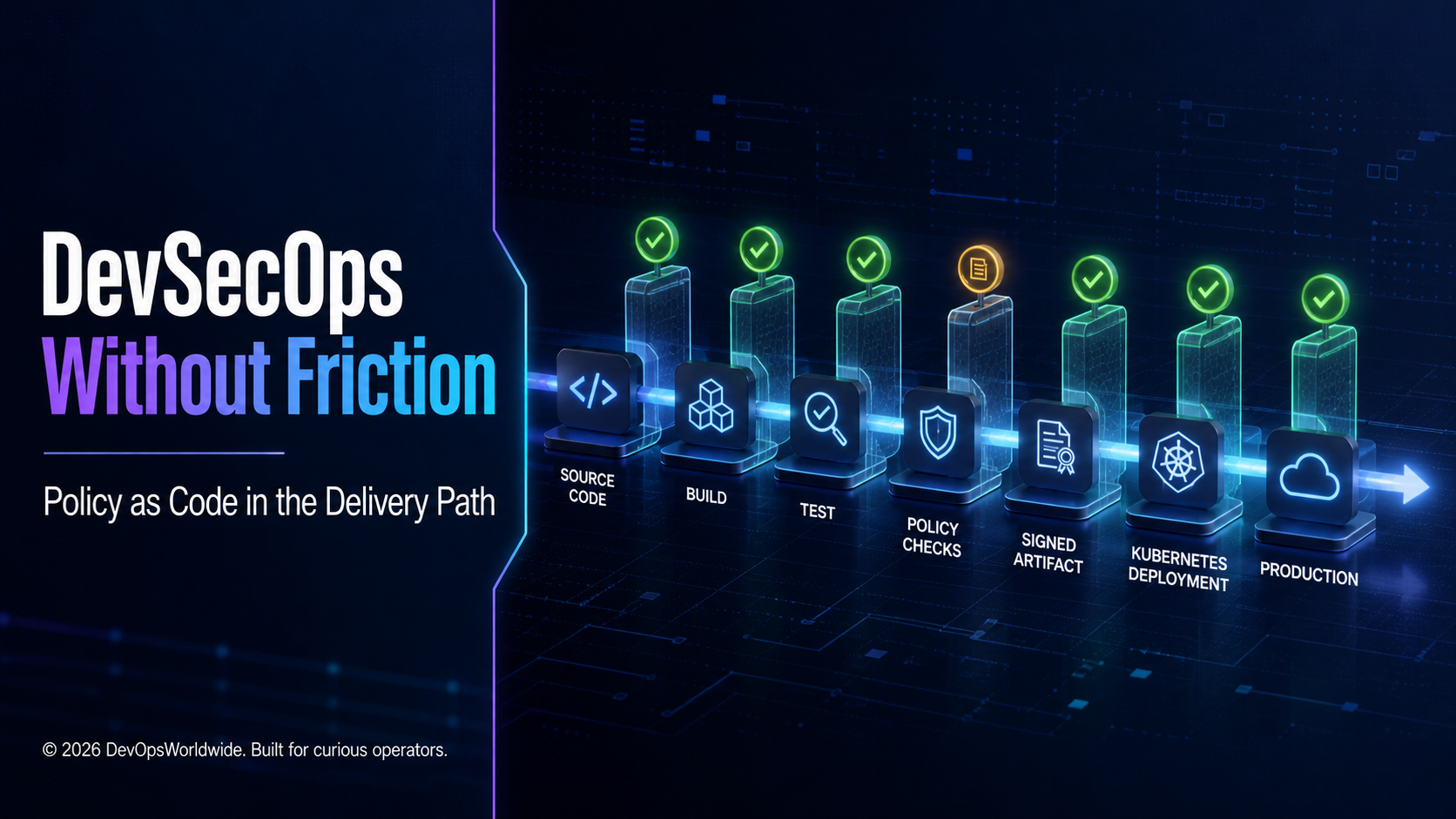
A practical delivery pattern
The following pattern works well for a platform team supporting many services:
Pull request
  ├─ Static checks: secrets, dependencies, IaC, manifests
  ├─ Policy evaluation: explain violations and recommended fixes
  ├─ Human review only for high-risk or approved exceptions
  ↓
Build
  ├─ Create a versioned artifact
  ├─ Attach provenance and scan evidence
  ↓
Promotion
  ├─ Verify artifact identity and target-environment policy
  ├─ Record the approval or exception
  ↓
Runtime
  └─ Detect drift and feed findings back into the policy backlog
The pipeline should be able to answer four questions quickly: what changed, which policy evaluated it, why did it pass or fail, and who accepted any exception?
Example: Kubernetes guardrails that help rather than surprise
Kubernetes is a natural policy-as-code environment because workloads are declarative. But a large, unprioritised ruleset can turn admission control into a deployment lottery.
Start with a narrow baseline:
apiVersion: apps/v1
kind: Deployment
metadata:
  name: checkout-api
  namespace: payments
spec:
  template:
    spec:
      containers:
        - name: api
          image: registry.example.com/checkout-api:2026.08.22
          securityContext:
            allowPrivilegeEscalation: false
            readOnlyRootFilesystem: true
          resources:
            requests:
              cpu: 200m
              memory: 256Mi
            limits:
              cpu: 500m
              memory: 512Mi
The early policies should cover controls that are both understandable and easy to remediate:
- No privileged containers in production namespaces.
- Required resource requests for schedulable workloads.
- No
latestimage tags in promoted environments. - Approved registry origins for production images.
- TLS for externally exposed ingress.
- A workload owner label and support channel.
The key is a progressive rollout. Report first, show teams the findings, provide a compliant starter template, then enforce the high-confidence rules. A good policy programme reduces exceptions over time because the platform makes compliant configuration easy to inherit.
The exception path is part of the control
Every mature delivery system needs exceptions. An emergency release, a legacy dependency, or a service-specific compatibility constraint may make a policy violation temporarily necessary. Pretending exceptions do not exist merely moves them into chat messages and undocumented manual changes.
Use a small, auditable exception record:
policy: production-image-registry
scope: inventory-service
reason: vendor image migration in progress
owner: platform-security
expires: 2026-09-30
follow_up: migrate image to approved registry
An exception should be narrow, time-bound, owned, and visible in the same review flow as the policy result. Expiry matters: it converts an accepted risk into scheduled work rather than permanent configuration drift.
Measure whether the guardrails are helping
Counting failed policy checks alone rewards noisy rules. Instead, measure delivery quality and the team experience together:
| Measure | What it tells you |
|---|---|
| Median time to remediate a policy finding | Whether failure messages and defaults are useful |
| Exception count and expiry rate | Whether controls are realistic and temporary |
| False-positive rate | Whether a policy is ready for enforcement |
| Findings detected before merge | Whether feedback is arriving early enough |
| Deployment lead time by risk tier | Whether security is adding proportionate friction |
| Repeat violations by service | Where templates, documentation, or coaching are needed |
Avoid a single “security score.” A team that identifies and resolves more issues before production may be improving, not failing.
A 30-day adoption plan
Week 1: select one service path
Choose a product with active delivery and supportive owners. Map its pull request, build, deploy, and runtime signals. Capture the two or three policy intents with the clearest risk and remediation path.
Week 2: codify and test
Add policies in report-only mode. Put compliant examples beside non-compliant examples. Add policy unit tests so that a future edit cannot silently weaken a control or introduce a noisy regression.
Week 3: fix the platform defaults
Where findings repeat, improve the golden path: CI templates, Helm charts, Terraform modules, repository scaffolding, or developer documentation. The platform should do more work than individual service teams.
Week 4: enforce one high-confidence rule
Choose a rule that has a low false-positive rate and a safe remediation. Announce the enforcement date, link the exception route, and watch the operational impact. Keep the rest in report mode until the evidence supports a stronger response.
Common failure modes
Treating policy as a compliance export
Generated evidence is useful, but policy that only exists for audit collection becomes stale. The best evidence is produced by controls that engineers actually use during normal delivery.
Blocking before the golden path exists
If a team cannot discover the compliant configuration in a starter template or documentation, a hard block turns into support debt. Fix the path, not only the rule.
Applying one severity to every environment
Production and a short-lived preview environment have different risk profiles. Keep the policy intent consistent while making enforcement proportional to the environment and exposure.
Hiding exceptions
Exceptions are data. They reveal product constraints, migration work, or an overly broad policy. Capture and review them rather than forcing engineers to find side doors.
Clear takeaways
- Put policy feedback close to the change, where it is cheaper to understand and fix.
- Begin with plain-language intent, then choose the policy engine and enforcement point.
- Make failure messages specific, owned, and actionable.
- Roll out gradually: inform, learn, enable, then enforce.
- Pair every guardrail with a documented, time-bound exception path.
- Measure delivery outcomes and developer experience—not only the number of blocked changes.
The strongest DevSecOps programmes do not ask engineers to slow down for security. They build security expectations into the paths engineers already trust, then use evidence to improve those paths continuously.